
Buying a home has become considerably more difficult over the past five to ten years, particularly for first-time buyers facing higher prices, mortgage rates and borrowing costs. In response, both the federal and Ontario governments have introduced or expanded several programs designed to reduce the upfront cost of buying a home and make homeownership more accessible.
Here are some of the most important changes buyers should know about in 2026.
New HST Relief for First-Time Buyers
One of the biggest recent changes is the new First-Time Home Buyers’ (FTHB) GST/HST Rebate, which was introduced in 2025 and became law on March 12, 2026. Eligible first-time buyers purchasing a qualifying newly built home (based on the purchase price before tax) or a substantially renovated home can receive a rebate of up to $50,000 on the federal portion of the HST. The full rebate is available on homes valued at up to $1 million, with the benefit gradually reduced on homes between $1 million and $1.5 million. Ontario has gone further by introducing additional provincial HST assistance, enacted in 2026 as well. For eligible new homes purchased between April 1, 2026 and March 31, 2027, the province’s enhanced rebate can provide up to $80,000 in provincial HST assistance.
Read more: Cabbagetown, Toronto’s Historic Village in the Heart of the City
Together, the federal and provincial measures can provide up to $130,000 in HST assistance on an eligible new home valued at $1 million, although eligibility requirements and the way the rebates are claimed vary. Importantly, this does not mean HST has been eliminated on every new home. The relief applies only to qualifying purchases and buyers who meet the applicable requirements.
More Help With Down Payments and Mortgages
The federal government has also made saving for a first home more flexible. The First Home Savings Account (FHSA) allows eligible first-time buyers to save with tax advantages, with an $8,000 annual contribution limit and a $40,000 lifetime limit. The Home Buyers’ Plan has also become more generous. Since 2024, eligible buyers can withdraw up to $60,000 from an RRSP to purchase a qualifying home, compared with the previous $35,000 limit.
Mortgage rules have changed as well. Since December 2024, 30-year insured mortgage amortizations have been available to all first-time buyers and buyers of new builds, while the price cap for insured mortgages increased from $1 million to $1.5 million. While a 30-year mortgage can mean paying more interest over the life of the mortgage compared with a 25-year amortization, the lower monthly payments can provide additional breathing room for buyers who may otherwise have difficulty qualifying for or carrying a mortgage under the traditional 25-year structure.
Land Transfer Tax Assistance for First-Time Buyers
Ontario’s first-time homebuyer provincial Land Transfer Tax (LTT) refund remains available, providing up to $4,000 in relief. For those purchasing within the City of Toronto, an additional Municipal Land Transfer Tax (MLTT) rebate of up to $4,475 is also available. Taken together, these measures represent a substantially different set of incentives than existed just a few years ago. While they do not eliminate the challenges of buying a home, they can make a meaningful difference to the upfront cost and affordability of homeownership for eligible purchasers — particularly those considering a new build.
What Could the Assistance Look Like on a $1 Million Home?
For illustration, assume the purchaser is a first-time buyer who qualifies for every applicable program and has sufficient FHSA and RRSP savings:
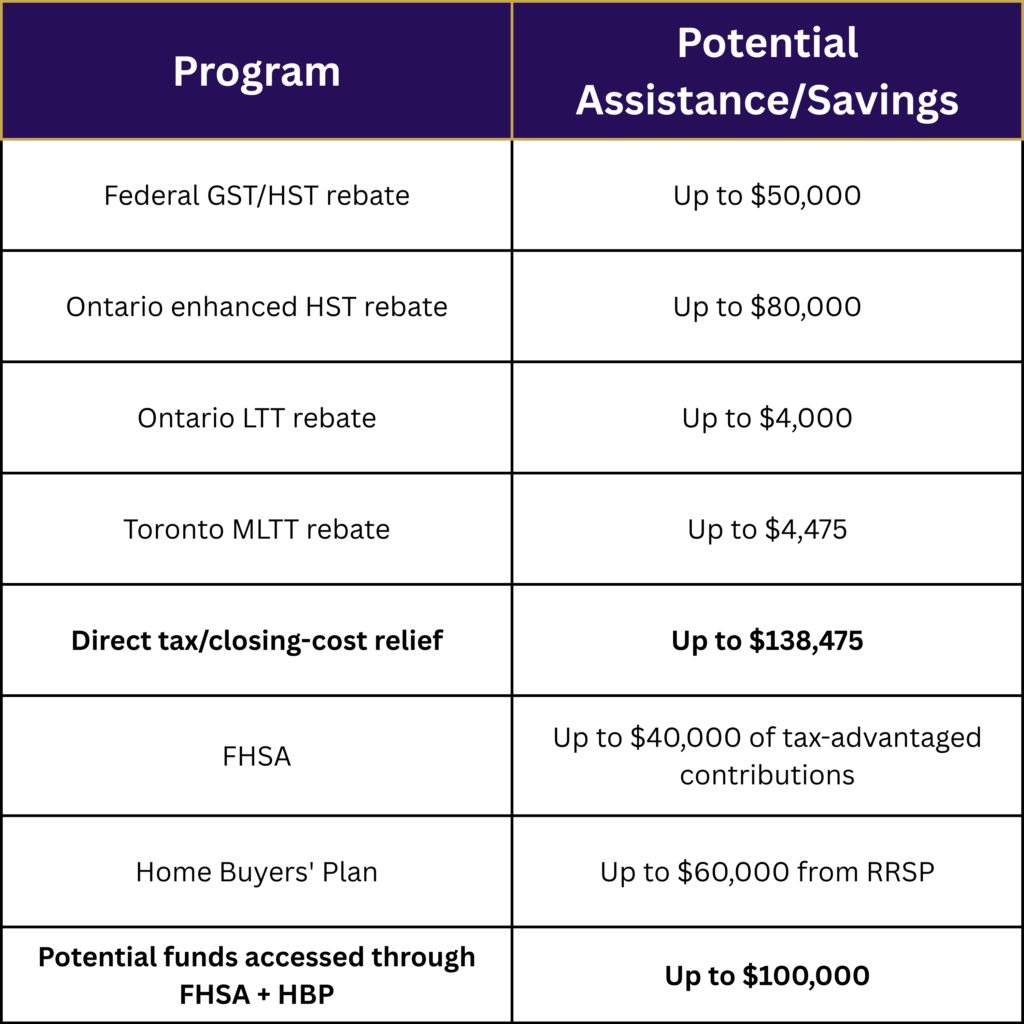
So, theoretically, a qualifying first-time buyer purchasing a $1 million new home could receive up to $138,475 in direct HST and land transfer tax relief, while potentially accessing another $100,000 of their own savings through the FHSA and RRSP Home Buyers’ Plan (HBP).
Read more: When a Basement Apartment Isn’t Legal: A Costly Lesson for Home Buyers
That does not mean the buyer receives $238,475 from the government. The FHSA and HBP amounts are primarily the buyer’s own money. The FHSA provides tax advantages for eligible contributions and withdrawals, while the HBP allows eligible RRSP savings to be withdrawn for a qualifying home purchase without immediate taxation, subject to the applicable rules and repayment requirements.
Additional Assistance for First-Time Buyers
In addition to closing-cost rebates and tax-advantaged savings accounts, first-time buyers should keep the federal First-Time Home Buyers’ Tax Credit (HBTC) in mind when tax season arrives. By claiming up to $10,000 on line 31270 of your personal tax return for the year you acquire your home, eligible buyers can receive a non-refundable tax credit worth up to $1,500 to help offset legal fees and moving expenses. Certain regional municipalities across Ontario also offer localized down-payment assistance programs for qualifying low- to moderate-income households, providing additional layers of support depending on where you plan to buy.
Thinking About Buying in the Greater Toronto Area?
Government incentives can be valuable, but understanding which ones actually apply to your situation is just as important. If you’re considering buying a home or condo in the GTA, contact me to discuss your options and find out what may be available to you.