

Toronto’s condo market has clearly corrected, but the scale of that decline, and the reasons behind it, are often misunderstood. While headlines may suggest a dramatic crash, the reality is more nuanced: prices have fallen meaningfully from their peak, but the decline reflects a combination of policy shifts, investor-driven design trends, and changing market fundamentals.
The Price Reset
At the peak of the pandemic-era boom, demand for smaller, relatively affordable condo units surged. By February 2022, the average price of a one-bedroom condo apartment in Toronto reached a staggering $719,446 (TRREB – The Habistat). Fast forward to April 2026, and that figure has dropped to $513,640, a decline of roughly 28.6% (TRREB – The Habistat).
This is not just a mild correction; it represents a full reset back to, and even below, many pre-pandemic price levels, when one-bedroom units at times traded above $600,000. The earlier surge in condo prices was fuelled not only by low interest rates and investor demand, but also by record levels of immigration to Canada, which intensified competition in the rental market and pushed rents to historic highs.
This trend is not limited to Toronto; other GTA hubs have seen even more dramatic shifts:
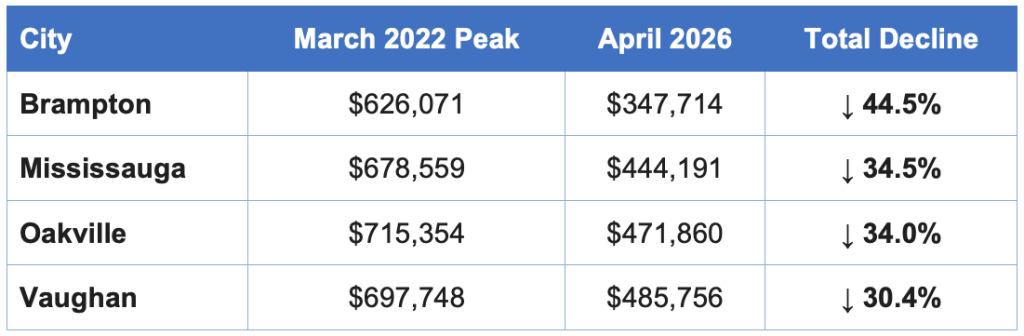
The above figures are alarming, especially for those persons who purchased a condo during the peak period and now, for any number of reasons, must sell.
The Impact of Policy and Foreign Capital
Part of the story lies in how the market was structured leading into that peak. Prior to 2017, foreign buyers faced virtually no additional taxes when purchasing residential real estate in Ontario. That changed with the introduction of the Non-Resident Speculation Tax (NRST), but even then, international capital still had relatively broad access to the market. It wasn’t until January 1, 2023, that the federal government implemented the Prohibition on the Purchase of Residential Property by Non-Canadians Act, which significantly restricted foreign buyers from purchasing homes — including condominium units — in Census Metropolitan Areas like Toronto. (Read Can Non-Canadian Citizens Buy Property in Canada?).
Read more: Mortgage Rates and the True Monthly Cost of Condo Ownership
This policy marked a major shift. For years, Toronto had been an attractive global asset class, and while foreign buyers represented a relatively small share of total transactions, their presence contributed to price acceleration and investor psychology. The removal of that demand, coinciding with rising interest rates, amplified the downward pressure on prices.
The Shrinking Unit: Designed for Yield, Not Life
However, policy alone doesn’t explain the magnitude of the correction. The type of product being built over the past decade also plays a critical role. Toronto’s condo market increasingly shifted toward smaller, investor-friendly units. According to Statistics Canada, condos built between 1971 and 1990 had a median size of roughly 1,000 square feet, while those built between 2016 and 2020 averaged closer to 650 square feet — a dramatic reduction. More recent data from the Municipal Property Assessment Corporation (MPAC) suggests this trend has continued, with new units built between 2020 and 2024 averaging just 616 square feet.
This downsizing wasn’t accidental. Developers, responding to high land costs and investor demand, optimized buildings for price-per-unit rather than livability. Smaller units meant lower entry prices and higher yields per square foot, making them attractive to investors. In fact, more than half of condos built between 2016 and 2020 in Toronto were owned as investment properties, according to the same Statistics Canada article noted above.
At the extreme end of this trend are micro-units. More broadly, provincial housing policy in recent years has moved toward limiting municipal restrictions on residential unit configurations and intensification, while Toronto has approved developments containing units under 300 square feet. Projects such as Smart House in downtown Toronto included suites as small as 276 square feet, illustrating how far the market shifted toward ultra-compact, investor-oriented housing. These units, while profitable to build, are often less functional for end-users and more sensitive to market downturns. When investor demand weakens — as it has in the current higher interest rate environment — these smaller units tend to see sharper price corrections.
This helps explain why the decline, most notably in one-bedroom condo prices, has been so pronounced. The segment is heavily weighted toward investor-owned, smaller units that are more exposed to shifts in financing costs and rental market expectations. As borrowing costs rose and rental growth stabilized, many investors stepped back, reducing demand for precisely the types of units that had driven the previous price surge. Still, policies enabled these types of developments to proliferate in the first place, often without fully considering the long-term interests of Canadian citizens and Ontarians themselves — many of whom recoil at the idea of living in such small, “New York-esque” dwellings.
At the same time, broader market conditions have shifted. Condo prices across Toronto have softened year-over-year, with increased inventory giving buyers more negotiating power. This is a stark contrast to the ultra-competitive conditions of 2021 and early 2022, when bidding wars were common even in the condo segment.
So how much have condo prices actually fallen? A lot. But it’s also important to recognize that this decline is not uniform across all condos. Larger, well-designed units in prime locations have generally held value better, while smaller, investor-oriented units, which are numerous, have borne the brunt of the correction.
A Market Rebalancing
Ultimately, Ontario’s condo market is not simply “crashing” — it is rebalancing after a period defined by cheap money, international capital flows, a global pandemic, and a development model centred on maximizing unit count over livability. The current downturn reflects both cyclical forces, like interest rates, and structural ones, including policy changes and the types of homes being built.
Although no one can say with certainty whether the market has fully bottomed out, for buyers with a long-term outlook and sufficient capital, this may represent a compelling opportunity to enter the condo market. Eventually, condo prices — including the growing inventory of newly built micro-units — are likely to rise again, even if many Ontarians continue to question whether such valuations are truly justified.
Let’s Navigate This Market Together
The data shows a massive shift, but your personal real estate goals shouldn’t be a casualty of the headlines. Whether you are looking to find a larger, more livable space at a “reset” price or need an honest valuation of your current investment, I am here to provide the clarity you need.
Have questions about how these price drops affect your specific neighbourhood? Reach out anytime and let’s cut through the noise and build a strategy that works for you.